
One of the reasons I keep coming back to science fiction is that it gives writers a way to put ordinary human beings in impossible situations.
Not merely dangerous situations—impossible ones.
A failing station. A hostile world. A war with no clean moral choices. A discovery that changes what everyone thought they understood. These are the kinds of situations that interest me most, because pressure reveals things comfort can hide.
In ordinary life, people can maintain the version of themselves they prefer. They can avoid certain questions. They can postpone difficult choices. They can tell themselves there will be time later to make things right, tell the truth, ask forgiveness, change course, or become someone braver than they have been.
But science fiction is very good at taking “later” away.
Pressure Reveals Character
A good science-fiction premise asks, What if? But the stories that stay with me usually ask something sharper:
What would this do to a person?
That question is at the heart of the novels I write.
In Ares, Mars is not just a setting. It is a place where ambition, loyalty, fear, and survival collide under conditions no one can fully control.
In Infernum, the extreme environment is not simply a backdrop. It becomes a crucible, forcing people to make choices they might never face in ordinary life.
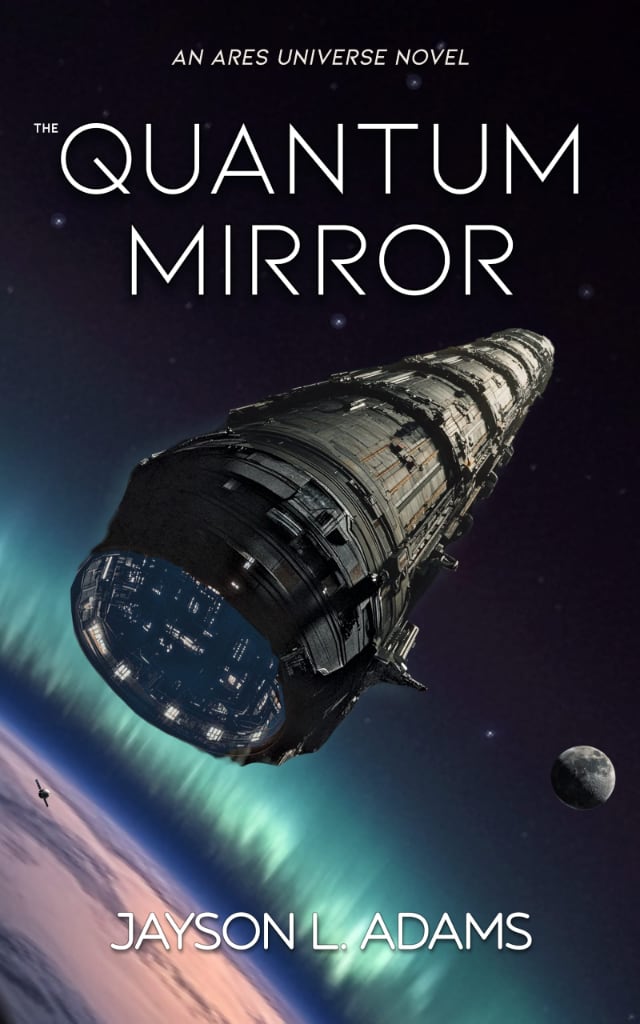
In The Quantum Mirror, Perun Station is more than a damaged research outpost. It is a sealed environment where pressure keeps building: physical pressure, psychological pressure, and moral pressure. The walls are closing in, systems are failing, and the people aboard cannot simply step outside the crisis and return to normal.
Why I’m Drawn to Isolated Worlds
That is why I keep returning to isolated settings.
A station.
A ship.
A planet.
A bunker.
A battlefield.
A place where escape is limited and consequences arrive quickly.
Isolation removes the easy exits.
Pressure removes the polite masks.
Science fiction gives those pressures scale. It allows a story to take a private human fear and externalize it as a world, a mission, a machine, a disaster, or a discovery.
The result can be thrilling, but the thrill matters most when it is attached to character.
What Survival Costs
I don’t think suspense comes only from wondering whether someone will survive. Often, the deeper suspense comes from wondering what survival will cost.
Who will they become?
What will they sacrifice?
What will they finally admit?
What will they do when the person they believed themselves to be is no longer enough for the situation in front of them?
That is the territory I keep returning to as a writer. Not science fiction as prediction. Not science fiction as gadgetry.
Science fiction as pressure.
Science fiction as revelation.
Science fiction as a way of asking what remains of us when the normal world falls away.
That is also the territory explored in The Quantum Mirror, now available in ebook, paperback, hardcover, and audiobook. To celebrate launch week, the ebook is just $0.99 through Wednesday, July 1.
Jayson L. Adams is a technology entrepreneur, artist, and the award-winning author of The Quantum Mirror, Ares, and Infernum.
His novels blend high-stakes science fiction, psychological tension, and character-driven suspense. Explore the books at www.jaysonadams.com.