
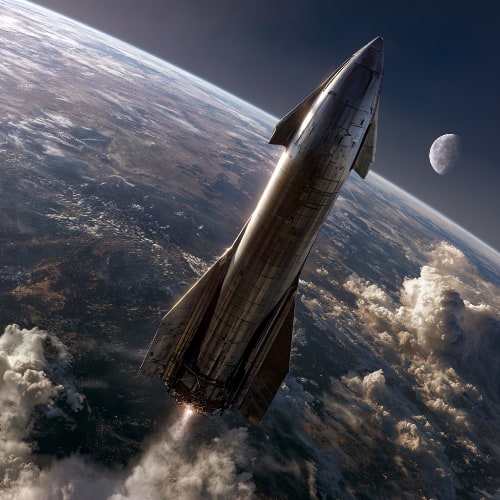
When most people think about NASA’s plans to return astronauts to the Moon, they think about rockets.
That’s understandable. Rockets are dramatic. When they fail, everyone notices. A launch explosion becomes front-page news. A successful launch generates excitement and optimism. But after watching the recent setbacks involving Starship and New Glenn, I’m becoming convinced that the biggest risk to NASA’s lunar ambitions isn’t any individual rocket.
It’s that the entire plan depends on multiple critical systems that are all still maturing at the same time.
Apollo Was Simpler Than We Remember
The Apollo program was one of the greatest engineering achievements in human history, but its architecture was surprisingly straightforward.
NASA built the Saturn V. The Saturn V launched astronauts toward the Moon. The crew landed, conducted their mission, and returned home.
Obviously, there was enormous complexity hidden beneath that description. But the basic transportation chain was relatively direct. The systems were designed specifically for the mission, and most of the critical elements were under NASA’s direct control.
The challenge was building the hardware.
Artemis presents a different challenge.
A Mission Built on Dependencies
NASA’s current return-to-the-Moon strategy relies on an interconnected collection of systems.
The Space Launch System must launch successfully. Orion must safely transport astronauts into lunar orbit. A lunar lander must already be available and ready to receive them.
That lander is where things become particularly interesting.
The current Human Landing System depends on Starship, a vehicle that remains under active development. Before it can support a lunar landing, Starship must demonstrate reliable operations, orbital refueling, long-duration cryogenic propellant storage, and the ability to transfer large quantities of fuel between spacecraft in orbit.
None of those capabilities are trivial. Several have never been demonstrated at the scale Artemis requires. Meanwhile, supporting infrastructure and launch systems continue to mature as well. Every one of these elements is progressing. But every one of them also carries technical and schedule risk.
The Problem Isn’t Failure
The problem isn’t that any of these systems are flawed.
Spacecraft development is difficult. Testing uncovers weaknesses. Engineers fix them. That’s how progress works.
Starship’s setbacks are not unusual for an ambitious launch system. Neither are New Glenn’s. The history of aerospace is filled with programs that struggled during development before eventually becoming reliable.
The concern is not that individual systems encounter problems. The concern is that NASA’s Moon Plan increasingly depends on multiple systems solving their problems on roughly the same timeline.
That’s a very different kind of challenge.
Why Interdependence Creates Risk
Engineers often worry less about individual failures than about interconnected ones. A delay in a single program can usually be managed. A delay in a launch vehicle combined with delays in spacecraft development, orbital refueling, mission operations, and supporting infrastructure becomes much harder to absorb. Each dependency becomes a potential bottleneck. Every schedule slip creates pressure elsewhere in the system.
The complexity doesn’t increase linearly.
It compounds.
This is why large engineering projects frequently struggle even when most of their individual components are performing reasonably well. Success requires everything to arrive at the finish line together.
Ecosystems Fail Differently Than Rockets
Apollo was fundamentally a transportation problem.
Artemis is an ecosystem.
Launch vehicles, spacecraft, landers, orbital refueling, cryogenic propellant management, mission operations, and multiple commercial partners all have to mature together.
That’s an elegant vision when everything works. But elegance and resilience are not the same thing.
The biggest threat to NASA’s Moon Plan isn’t any individual rocket failure. It’s the possibility that multiple critical systems experience delays at the same time.
Rockets fail dramatically. Ecosystems fail quietly.
A launch explodes and everyone notices. A complex network of interdependent technologies slips six months here, nine months there, and suddenly the entire schedule moves years into the future.
That’s the challenge facing Artemis.
Getting back to the Moon is no longer just a question of building a powerful rocket. It’s a question of whether an entire ecosystem can reach operational maturity together.
Jayson L. Adams is a technology entrepreneur, artist, and the award-winning author of The Quantum Mirror, Ares, and Infernum.
His novels blend high-stakes science fiction, psychological tension, and character-driven suspense. Explore the books at www.jaysonadams.com.