
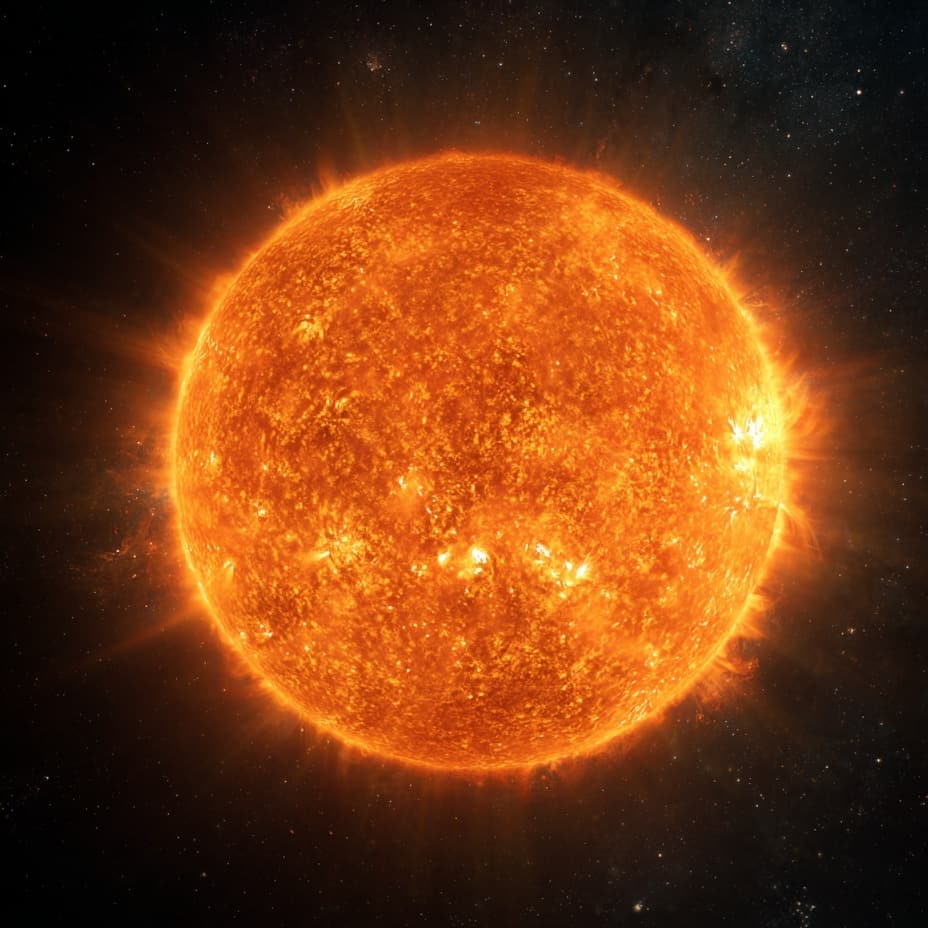
When you look up at the sky, feel the warmth of sunlight, you probably assume the explanation is straightforward. The sun is a massive furnace. Hydrogen atoms collide, fuse into helium, and release energy. That energy radiates outward and eventually reaches Earth.
That story is clean, intuitive, and widely taught.
It is also incomplete in a way that borders on unsettling, because if you actually apply classical physics to the sun’s core, you arrive at a very different conclusion:
The sun shouldn’t shine.
The Barrier That Should Stop Everything
At the heart of the problem is something deceptively simple: electric charge.
Protons—the nuclei of hydrogen atoms—are positively charged. Like charges repel, and that repulsion is not subtle. The electromagnetic force is extraordinarily strong, vastly stronger than gravity at small scales. When two protons approach each other, they encounter a steep energy barrier known as the Coulomb barrier.
To fuse, they must get close enough for the strong nuclear force to take over. That force binds them together and releases energy, but it only operates at extremely short distances. The protons have to effectively touch.
The question, then, is whether they can get that close.
The answer, if you rely on classical physics, is no.
Not Hot Enough to Burn
The core of the sun reaches temperatures of about 15 million degrees Celsius. That sounds extreme, but temperature is just a measure of particle motion. It tells you how fast the protons are moving.
When physicists calculate those speeds, they find that most protons simply do not have enough energy to overcome their mutual repulsion. They rush toward each other, slow as the electrical force pushes back, and then reverse direction.
Over and over again.
If the sun operated purely under classical rules, these near-collisions would never become actual collisions. Fusion would not occur at any meaningful rate. The sun would be a dim, cooling sphere of gas, slowly collapsing under its own gravity.
There would be no steady source of light. No long-lived star. No Earth as we know it.
The Quantum Loophole
And yet, the sun shines.
The resolution to this contradiction lies in abandoning the idea that particles are small, solid objects with precise locations. At quantum scales, that picture breaks down. Particles behave like waves—spread out, described by probabilities rather than certainties.
This shift allows for something that classical physics forbids.
When a proton approaches another, it does not exist at a single point. Its “wavefunction” extends into space, including into regions it does not have enough energy to classically occupy. That extension is not large, but it is not zero.
Occasionally, that is enough.
Instead of climbing over the energy barrier, the proton effectively appears on the other side of it. This is quantum tunneling—not a process of breaking through, but of bypassing the barrier altogether through the probabilistic nature of quantum mechanics.
When that happens, the strong nuclear force takes over instantly. Fusion occurs. Energy is released.
This is not the dominant behavior. It is the exception.
But it is the exception that powers the sun.
Rare Enough to Matter
What makes this even more remarkable is how infrequently it happens.
For any individual proton in the sun’s core, the average time before it participates in a fusion event is measured in billions of years. Most protons spend their entire existence colliding, repelling, and separating without ever fusing.
That inefficiency is not a flaw in the system. It is the reason the system works.
If fusion were easy—if protons could routinely overcome the Coulomb barrier—the sun would burn through its fuel rapidly. Instead of a stable star lasting billions of years, it would be a brief, violent explosion.
The sun shines because fusion is difficult, and because quantum mechanics allows it to happen just often enough.
A Star Built on Improbability
What emerges from this is a picture of the universe that is very different from the rigid, deterministic machine imagined in classical physics.
Barriers are not absolute. They are statistical. Events that are “impossible” in a classical sense become merely “extremely unlikely” in a quantum one. Given enough particles and enough time, extremely unlikely events become inevitable.
The sun is not a roaring furnace in the conventional sense. It is a vast collection of particles, most of which fail to fuse, with a tiny fraction succeeding through a mechanism that should not exist in a classical world.
And yet, those rare successes are enough.
The Light We Take for Granted
Every photon that reaches Earth traces its origin back to one of these improbable moments when a proton did not behave like a classical object and instead followed the strange rules of quantum mechanics.
Those events are rare, but the sun is enormous. With enough protons, rare becomes constant.
That is why the sky is bright. That is why the planet is warm. And that is why life has had the time and energy to emerge and evolve.
The sun shines not because the rules are simple and predictable, but because, at the smallest scales, the universe allows for exceptions.
And those exceptions, accumulated over billions of years, are the reason the sun shouldn’t shine—and yet does.
Jayson L. Adams is a technology entrepreneur, artist, and the award-winning author of The Quantum Mirror, Ares, and Infernum.
His novels blend high-stakes science fiction, psychological tension, and character-driven suspense. Explore the books at www.jaysonadams.com.