
One of the strangest things about the Space Age is that we’ve spent decades thinking of space as empty.
It isn’t.
At least not anymore.
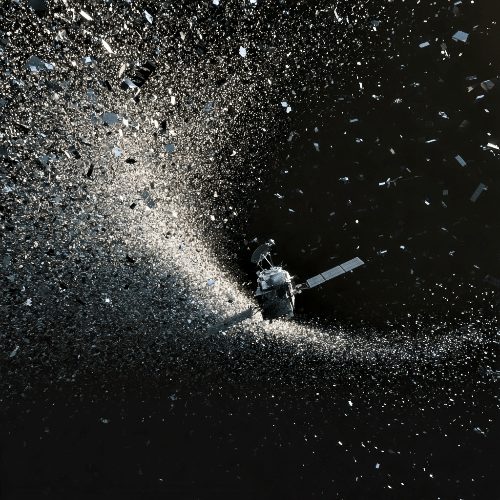
Thousands of active satellites now circle the Earth, joined by millions of pieces of debris ranging from spent rocket stages to fragments no larger than a paint chip. Individually, most of these objects pose little threat. Collectively, they have created a new engineering challenge that didn’t exist when the first satellites were launched.
It’s called the Kessler Syndrome, and it’s one of those ideas that’s both elegant and unsettling.
A Chain Reaction in Orbit
In 1978, NASA scientist Donald Kessler proposed a simple idea.
Imagine two satellites colliding in orbit. At orbital velocities—roughly 17,000 miles per hour—that isn’t just a crash. It’s an explosion.
The collision produces thousands of fragments, each one continuing around the Earth at several kilometers per second. Those fragments can strike other satellites, producing still more debris, which in turn creates additional collisions.
One accident becomes many.
The concern is that beyond some critical density of objects, the process could become self-sustaining. Even if humanity stopped launching satellites entirely, collisions would continue generating more debris, making some orbital regions increasingly hazardous for decades or even centuries.
Space Is Becoming Infrastructure
When Kessler proposed the idea, it was largely theoretical.
Today, it feels much more relevant.
Companies are deploying satellite constellations numbering in the thousands. Governments rely on orbital infrastructure for communications, navigation, weather forecasting, military operations, and scientific observation. Space is no longer just a destination.
It’s infrastructure.
That makes orbital traffic management every bit as important as air traffic management on Earth.
The difference is that an abandoned airplane eventually lands.
An abandoned satellite may remain in orbit for decades.
Velocity Changes Everything
People often imagine space debris as drifting lazily through space.
The reality is much more violent.
Relative velocities between objects in low Earth orbit can exceed 30,000 miles per hour. At those speeds, even a bolt or a fleck of paint carries enormous kinetic energy. Something only a few millimeters across can cripple a spacecraft.
That’s why satellites constantly perform collision avoidance maneuvers, and why organizations around the world spend so much effort tracking tens of thousands of objects orbiting our planet.
The danger isn’t the size of the debris.
It’s the speed.
Success Creates New Problems
One of the recurring themes in technology is that success often creates entirely new categories of risk.
The automobile gave us traffic jams.
The internet gave us cybersecurity.
Artificial intelligence raises questions about misinformation and trust.
And inexpensive access to space has given us orbital congestion.
None of these problems are arguments against the technology itself. They’re reminders that every technological revolution changes the environment in which it operates.
Keeping Space Usable
The good news is that Kessler Syndrome remains a risk, not an inevitability.
Satellite operators routinely maneuver to avoid collisions. New spacecraft are increasingly designed to deorbit at the end of their missions rather than becoming permanent hazards. Researchers are developing technologies to remove large pieces of debris before they can create even more.
Those efforts matter because low Earth orbit is becoming one of humanity’s most important resources.
The irony is that space still feels unimaginably vast when you look up at the night sky.
But the narrow shell of orbit we depend on is surprisingly crowded.
Sometimes the greatest danger isn’t running out of space.
It’s forgetting just how little of it we actually use.
Jayson L. Adams is a technology entrepreneur, artist, and the award-winning author of The Quantum Mirror, Ares, and Infernum.
His novels blend high-stakes science fiction, psychological tension, and character-driven suspense. Explore the books at www.jaysonadams.com.