
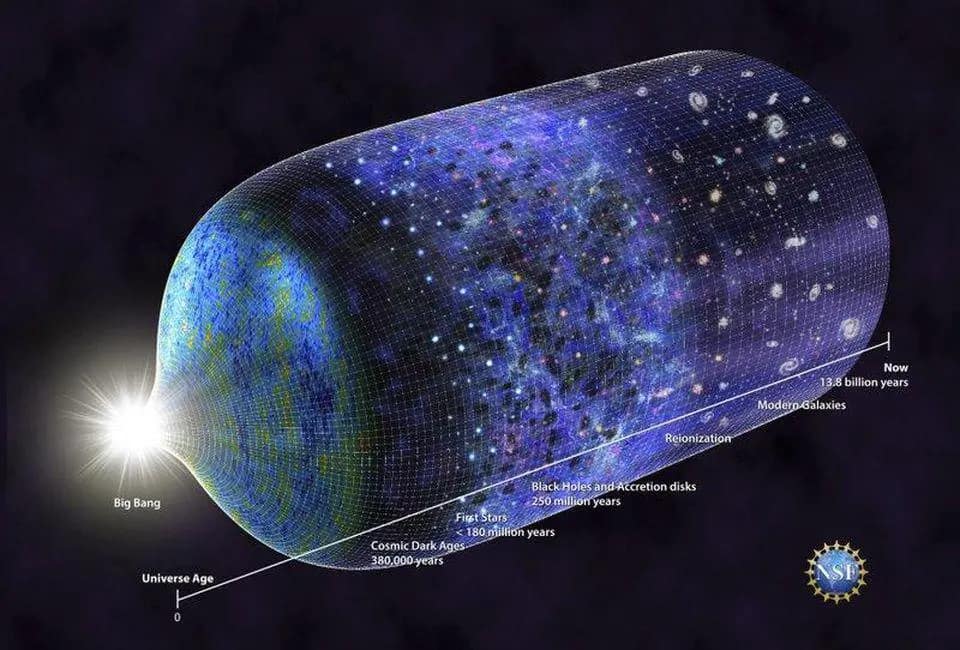
The cosmic microwave background (CMB) has long been treated as the most reliable timestamp in the universe. It’s supposed to be the afterglow of the Big Bang, a snapshot from just 380,000 years after the beginning of everything—when the universe cooled enough for light to travel freely. It’s also the cornerstone of the ΛCDM model, the standard framework for modern cosmology.
But what if that interpretation is wrong?
A new paper, based on data from the James Webb Space Telescope, argues that the CMB might not be a fossil record of the Big Bang at all, but instead, the redshifted and thermalized light of early, massive galaxies. If true, this changes everything. And I mean that in the literal sense: our estimate of the universe’s age would no longer hold.
CMB as a Misread Signal
I discussed the potential problems with the CMB in an earlier blog post, but I’ll recap it here. The logic is deceptively simple. The early universe, as revealed by JWST, appears to have formed bright, large galaxies far earlier than predicted. Those galaxies would have been hot, luminous, and dust-rich. Their light, scattered and thermalized by surrounding material, could create a diffuse glow. Now redshift that glow over 13 billion years of cosmic expansion, and you get a background signal that looks a lot like the CMB.
In fact, the paper estimates that these early galaxies could account for up to the full present-day energy density of the CMB. If even a fraction of that holds, the implications are extraordinary.
Why That Changes the Clock
The CMB, in the standard model, gives us a time anchor: 13.8 billion years ago, give or take, the universe emerged from a hot, dense plasma. The CMB we see today is the cooled-down afterglow of that moment.
But if the CMB is instead light from already-mature galaxies, then the event we’ve been treating as the universe’s birth wasn’t the beginning. It was just another chapter, maybe a middle one. The galaxies that produced this radiation must have formed before it, which implies that the universe is significantly older than we think.
That turns the cosmic microwave background into a lower bound, not a definitive starting point.
Explaining JWST’s “Impossible” Galaxies
This reinterpretation doesn’t just shake up theory, it could solve a growing observational mystery. JWST has revealed massive, well-structured galaxies existing just 100 million years after the supposed Big Bang.
That’s wildly out of sync with ΛCDM, which struggles to explain how galaxies could assemble, grow, and evolve that fast. If the universe is older than we thought, those galaxies aren’t outliers, they’re right on schedule.
What once seemed impossible becomes expected.
Beyond the Standard Model
To be clear, this new interpretation doesn’t deny cosmic expansion, or even the Big Bang as a general idea. But it does challenge the specific framework—dark energy, dark matter, and CMB-based parameter tuning—that defines the ΛCDM model.
If our deepest assumptions about the CMB are flawed, the rest of the model falls like dominoes.
And what replaces it? We don’t know yet. But this paper might mark the first crack in the wall—not because it offers a full alternative, but because it dares to ask a forbidden question:
What if the universe is far older than we think?
Jayson L. Adams is a technology entrepreneur, artist, and the award-winning and best-selling author of two science fiction thrillers, Ares and Infernum.
Jayson writes sci-fi thrillers that explore what extreme situations reveal about who we really are. His novels combine high-stakes science fiction with deeper questions about identity, courage, and human nature. You can see more at www.jaysonadams.com.