
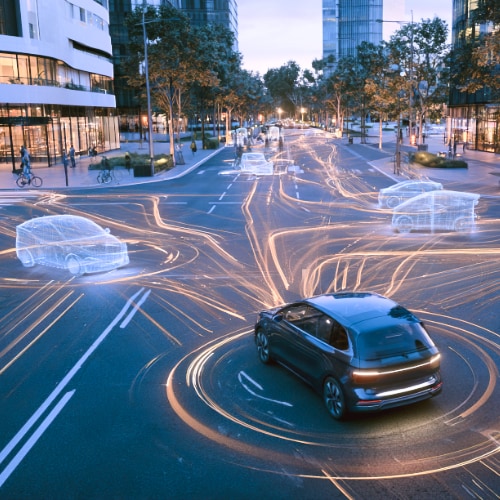
Imagine you’re riding in a self-driving car when its brakes fail. Ahead, five pedestrians are crossing the street. The car can continue straight, killing all five, or swerve into a concrete barrier, killing you instead.
What should it do?
This is a variation of the famous trolley problem, a philosophical thought experiment that asks whether it’s morally acceptable to sacrifice one life to save several others.
MIT researchers explored this dilemma in their 2016 study, The Social Dilemma of Autonomous Vehicles. Their later Moral Machine experiment collected nearly 40 million decisions from people around the world, revealing some fascinating contradictions in human morality.
But there’s a fundamental problem with applying the trolley problem to self-driving cars.
It assumes we know what’s going to happen.
The Problem with Predicting the Future
In the classic trolley problem, the outcomes are certain. Pull the lever and one person dies. Do nothing and five people die.
Real driving doesn’t work that way.
Imagine a self-driving car approaching an unexpected obstacle. Should it brake or swerve? Braking might prevent a collision, or cause the car behind it to crash. Swerving might avoid a pedestrian but send the car into oncoming traffic.
The car can’t know what will happen. It can only estimate probabilities.
In fact, a 2019 paper by philosopher Rebecca Davnall argued that the traditional trolley problem largely ignores vehicle dynamics and uncertainty. In many emergency scenarios, braking in a straight line is likely the least risky response.
But there’s an even more interesting problem with the trolley analogy.
The Trolley Problem Never Ends
We imagine the trolley problem as a single dramatic moment when a machine must choose who lives and who dies.
In reality, a self-driving car is making decisions that affect people’s safety every second.
Should it travel at 35 mph or 33? How closely should it follow another vehicle? Should it give a cyclist more room, even if doing so moves it closer to oncoming traffic?
Every decision changes the probability of an accident, and who might be hurt if one occurs.
Even maintaining its current speed and position is a decision.
A 2024 study examined how people thought autonomous vehicles should distribute these everyday risks. Interestingly, participants were willing to accept slightly greater risks themselves to reduce the risks to others.
The point is that moral decisions aren’t confined to rare emergencies. They’re embedded in ordinary driving.
What Makes a Decision Right?
This raises a question that’s arguably more interesting than the original trolley problem:
If a self-driving car makes the statistically safest decision and someone dies anyway, was it the wrong decision?
We tend to judge decisions by their outcomes. But a good decision can have a terrible outcome, just as a reckless decision can turn out well.
Autonomous vehicles must constantly evaluate possible futures, weigh competing risks, and act without knowing exactly what will happen.
And unlike human drivers, whose decisions vary with experience, attention, and instinct, self-driving cars can apply the same principles consistently across millions of vehicles.
The challenge isn’t programming a car to make the right choice between two known outcomes. It’s programming a car to make the best possible decision when neither outcome is known.
Jayson L. Adams is a technology entrepreneur, artist, and the award-winning author of The Quantum Mirror, Ares, and Infernum.
His novels blend high-stakes science fiction, psychological tension, and character-driven suspense. Explore the books at www.jaysonadams.com.