
Google has always been an engineering powerhouse. Search, Maps, Gmail, Android, Chrome, YouTube infrastructure, TensorFlow, DeepMind—the company has shaped the modern internet and helped define the AI era.
Marketing, however, remains a different story.
The latest example is Gemini Intelligence, Google’s newly introduced name for proactive AI features on Android. Google describes it as “the best of Gemini” brought to Android devices, with features that automate multi-step tasks, summarize information, help fill out forms, and create custom widgets through natural language.
The technology may be useful (maybe). The name is the problem.
Apple Intelligence, With a Google Accent
Let’s be honest: Gemini Intelligence sounds like a riff on Apple Intelligence.
Apple’s name drew plenty of eye rolls when it launched. It was cute, maybe too cute. But the logic behind it was clear. Apple positioned Apple Intelligence as a “personal intelligence system” for iPhone, iPad, and Mac, combining generative models with personal context.
In other words, Apple tried to redefine “AI” on its own platforms. AI, in Apple’s telling, does not merely mean Artificial Intelligence. It means Apple Intelligence.
That is classic Apple branding. A little smug? Sure. But coherent.
Apple would never have called it iOS Intelligence or Mac Intelligence, because those names would narrow the concept to a product line. Apple Intelligence works because Apple is the umbrella. It connects the whole ecosystem. They were also playing with the meaning of AI.
Google apparently looked at that and said, “Great. Let’s do the same thing, but with the name of our AI product jammed in front.”
And the rest, as they say, is history.
Gemini Intelligence?
Google spent decades building one of the most valuable brands on Earth. It owns the word “Google” in a way few companies own anything. “Google it” became a verb. That is branding magic most companies would pay billions to manufacture.
So naturally, when Google needed a broad name for its AI layer across Android, Chrome, and services, it chose Gemini Intelligence.
Really?
The phrase doesn’t exactly roll off the tongue. It sounds redundant, like “intelligent intelligence.”
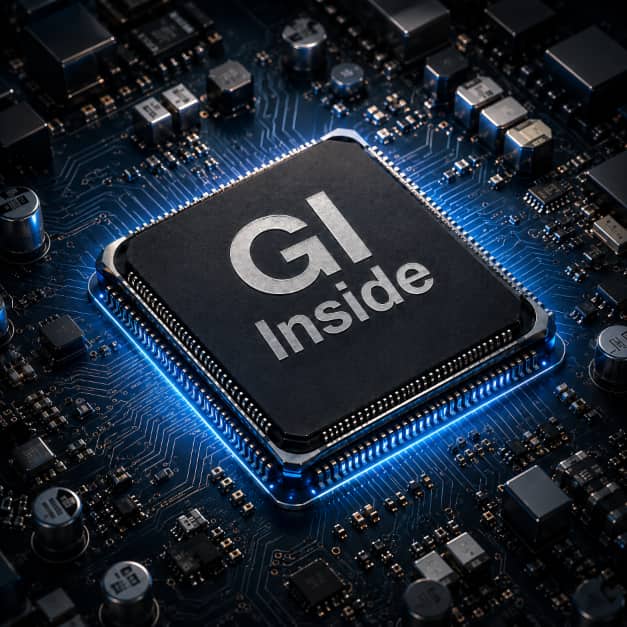
It also creates the deeply unfortunate abbreviation GI.
But hey, at least it’s not Bard Intelligence, which would have given us BI. Bard itself was already a head-scratcher: literary, soft, and strangely disconnected from Google’s identity. Google eventually replaced Bard with Gemini, and Gemini has become the company’s central AI brand. That is fine. But “better than Bard” should not be the benchmark. Gemini may work as the name of an assistant, but Gemini Intelligence sounds like a label created to satisfy a branding hierarchy rather than a phrase any normal person would say out loud.
The Engineering Brain vs. the Marketing Brain
This is the eternal Google tension. The company can solve impossibly hard technical problems, then name the result like it came out of a committee that had three whiteboards, six vice presidents, and no one willing to say, “This sounds weird.”
Google’s product graveyard already tells the story: Hangouts, Allo, Duo, Meet, Chat, Messages. And who can forget (or follow) Google Wallet, which became Android Pay, merged into Google Pay, and eventually came full circle back to Google Wallet—except “Google Pay” still stuck around as the name for the payment service.
In that spirit, Assistant became Gemini. Bard became Gemini, too. Now Gemini becomes Gemini Intelligence. The pieces may make sense internally, but consumers do not live inside Google’s org chart.
Great branding reduces friction. It makes the product easier to understand, easier to remember, and easier to talk about. Gemini Intelligence does the opposite. It asks users to parse Google’s hierarchy: Gemini the model, Gemini the assistant, Gemini in Android, Gemini Intelligence as a feature layer, and Google as the company behind all of it.
That is not a brand architecture. That is a filing cabinet.
The Rebrand Is Already Writing Itself
Here’s my prediction: somewhere inside Google, the debate was probably between Google Intelligence and Gemini Intelligence.
The Gemini side won because Gemini is the AI brand. That sounds logical in a conference room. But brands do not live in conference rooms. They live in people’s mouths, search bars, headlines, settings screens, and memory.
Eighteen months from now, do not be surprised if Google “simplifies” the naming and rebrands the whole thing as Google Intelligence.
And honestly? That would sound better.
It would still feel derivative. It would still invite comparisons to Apple. It would still carry the burden of Google trying to market its way out of a paper bag. But at least “Google Intelligence” has scale. It points to the company, not just one product family. It gives Google the umbrella Apple already understood it needed.
Or maybe they could just use the name Apple Intelligence—after all, Apple chose Gemini as its backend AI engine.
Until then, they’re stuck with Gemini Intelligence. A name that may describe the future of Android AI, but lands with all the elegance of a medical billing code. Smart technology with a dumb label. And for Google, that feels painfully on brand.
My GI tract will recover. Eventually.
Jayson L. Adams is a technology entrepreneur, artist, and the award-winning author of The Quantum Mirror, Ares, and Infernum.
His novels blend high-stakes science fiction, psychological tension, and character-driven suspense. Explore the books at www.jaysonadams.com.