
In Star Trek: The Motion Picture, the Enterprise takes nearly two hours to travel from Earth to Jupiter. That’s an astonishingly fast journey, but it illustrates just how enormous the distances within our own solar system really are.
That’s surprisingly slow for a starship, isn’t it?
Actually, it’s astonishingly fast. Depending on the relative positions of Earth and Jupiter, the trip would take light itself between 35 and 52 minutes. The Enterprise is traveling at a substantial fraction of the speed of light.
And it still takes nearly two hours just to reach Jupiter.
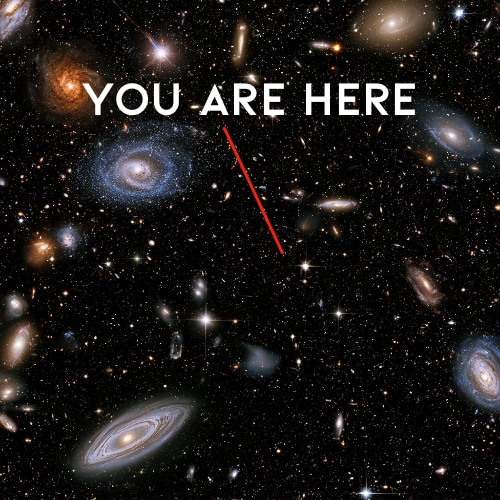
Space is big. Really, really big.
When 300 Times the Speed of Light Isn’t Fast Enough
I encountered this problem firsthand while writing my science fiction novel Infernum.
In one scene, the starship Avenger must maneuver around an enormous red hypergiant star, skim past a black hole, and approach a nearby planet, all while trying to evade detection by hostile forces.
I wanted the sequence to play out against a ticking clock. Sixty seconds of increasingly tense action as the ship races around the star, its hull temperature climbing toward catastrophic levels.
Then I started working out the math.
The problem was the sheer scale of the star system. To cover the required distances in the time I’d allotted, the Avenger would have to travel at hundreds of times the speed of light.
I eventually settled on 380c, or 380 times light speed.
That number blew my mind. I’d already given my fictional starship the ability to travel faster than light, something our current understanding of physics doesn’t permit. And now I was discovering that even that wasn’t nearly fast enough!
Just How Fast Is 300c?
To appreciate how extraordinary this speed is, consider how long it would take a spaceship traveling at 300 times the speed of light to reach some familiar destinations.
| Destination | Travel time at 300c |
|---|---|
| Moon | 0.004 seconds |
| Mars (closest approach) | 0.6 seconds |
| Jupiter (farthest separation) | 10 seconds |
| Neptune | 48 seconds |
| Proxima Centauri | 5.2 days |
| Across the Milky Way | 333 years |
| Andromeda Galaxy | 8,333 years |
Even at this fantastic speed, reaching the nearest star takes more than five days. Crossing our own galaxy takes over three centuries.
And the nearest major galaxy? More than eight thousand years.
The Universe Doesn’t Make It Easy
Science fiction has accustomed us to spaceships zipping between stars as casually as airplanes fly between cities.
But the distances involved are almost beyond human comprehension.
Light travels approximately 186,000 miles every second. In a single second, it could circle Earth more than seven times. Yet even at that speed, it takes more than four years to reach the nearest star.
When writing Infernum, I thought giving my characters faster-than-light travel would solve the problem of getting them where they needed to go.
Instead, I discovered just how enormous the universe really is.
Even when you cheat the laws of physics, space still makes you pay for every mile.
Jayson L. Adams is a technology entrepreneur, artist, and the award-winning author of The Quantum Mirror, Ares, and Infernum.
His novels blend high-stakes science fiction, psychological tension, and character-driven suspense. Explore the books at www.jaysonadams.com.