
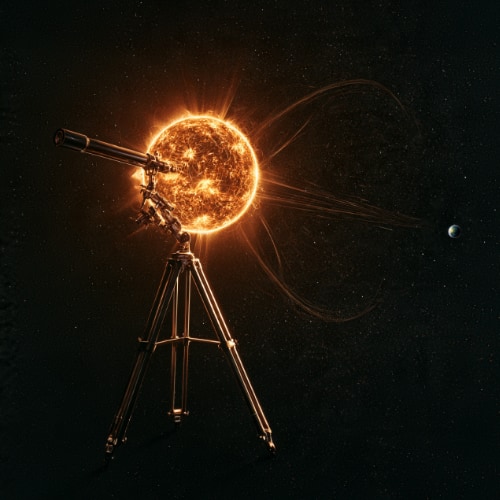
Astronomers keep building bigger telescopes. Hubble has a 2.4-meter mirror. James Webb stretches that to 6.5 meters. Future observatories will undoubtedly push the limits further. But eventually you run into an obvious problem.
Big mirrors are hard.
They’re heavy. They’re fragile. They have to survive launch. And if you want dramatically better resolution, sooner or later you start talking about telescopes so large that building and launching them becomes absurd.
So what if we didn’t build the lens at all? What if we used one that’s already there? One that’s about 865,000 miles across.
The Sun.
Einstein to the Rescue
According to Einstein’s general theory of relativity, massive objects bend spacetime. Light passing close to something massive therefore follows a curved path. We see this routinely in astronomy. Massive galaxies and galaxy clusters bend and magnify light from objects behind them, a phenomenon called gravitational lensing.
The Sun does the same thing.
Light from a distant object passing on opposite sides of the Sun can be bent inward by its gravity. Travel far enough beyond the Sun, line everything up precisely, and those rays begin to converge. That creates what astronomers call the solar gravitational lens.
And its potential is extraordinary.
NASA-funded research has explored using it to directly image Earth-like planets around other stars. A relatively modest telescope placed in the Sun’s gravitational focal region could exploit the Sun’s enormous natural magnification instead of relying entirely on a gigantic manufactured mirror.
There Is, Of Course, a Catch
Unfortunately, the focal region doesn’t begin just beyond Mars.
Or Jupiter.
Or Pluto.
It starts at roughly 548 astronomical units from the Sun. One astronomical unit is the distance between Earth and the Sun. Pluto averages roughly 40 AU away. So we’re talking about putting a telescope more than thirteen times farther out than Pluto.
Voyager 1, launched in 1977 and now the most distant human-made object, has taken nearly fifty years to reach only about one-third of the way to the Sun’s gravitational focal region.
So getting there would be one of the harder engineering problems humanity has ever tackled. Researchers have proposed using fleets of small spacecraft and advanced solar sails to reach the necessary distance much faster than our existing deep-space probes. NASA has funded several stages of work on the concept, although this remains a technology study rather than an approved mission.
But getting there is only part of the challenge.
The spacecraft would have to line up with the Sun and one particular exoplanet with extraordinary precision. Light from that planet would appear as an Einstein ring around the Sun, and the telescope would have to move through the projected image and collect enough information to reconstruct the planet computationally.
This is not point-and-shoot photography.
But Imagine the Payoff
Today, even the exoplanets we can directly observe are essentially points of light. A solar gravitational lens could change that.
NASA researchers have calculated that a mission observing an Earth-like planet roughly 100 light-years away could potentially reconstruct surface features at scales of around 25 kilometers after months of observations.
Think about what that means. Not merely detecting that a planet exists. Not simply measuring oxygen, methane, or water in its atmosphere. Actually producing a map.
Continents.
Oceans.
Cloud systems.
Perhaps seasonal changes.
We could potentially look at another Earth-like world as a world, rather than as a few photons hidden in the glare of its star.
A Telescope the Size of the Sun
There are enormous practical problems to solve before anything like this flies. But that’s what makes the idea so fascinating.
We often imagine that seeing farther requires building ever larger machines. But sometimes the better solution is to realize that nature has already built something far larger than anything we possibly could.
The most powerful telescope humanity might ever use may not have a giant mirror.
It may not even look like a telescope.
It may consist of a small spacecraft, unimaginably far from home, using an entire star as its lens.
Jayson L. Adams is a technology entrepreneur, artist, and the award-winning author of The Quantum Mirror, Ares, and Infernum.
His novels blend high-stakes science fiction, psychological tension, and character-driven suspense. Explore the books at www.jaysonadams.com.