
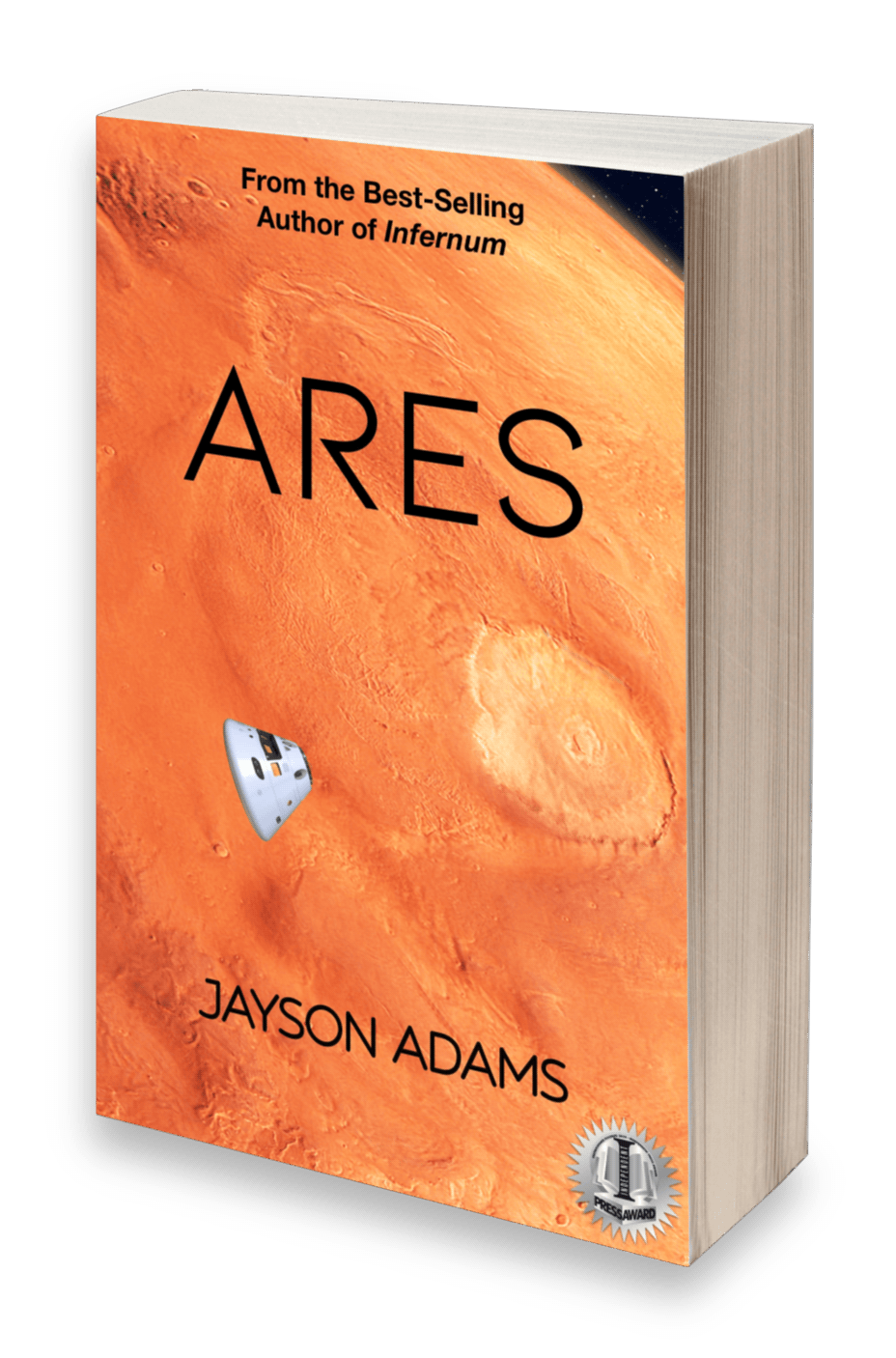
When I wrote Ares, I needed a reason why enormously powerful government institutions might find themselves desperate for resources.
So I gave the United States an $85 trillion national debt.
At the time, that seemed comfortably like science fiction.
This summer, the real U.S. national debt crossed $40 trillion.
Suddenly, $85 trillion doesn’t feel quite as safely fictional as it once did.
Mars Is Only Part of the Story
On the surface, Ares is a book about the first crewed mission to Mars.
There are spacecraft. There’s a Mars landing. There are all the dangers you would expect when human beings travel tens of millions of miles from Earth and attempt to survive on another planet.
But the space exploration is really only one layer of the story.
At one point in the novel, a character tells Commander Kate Holman:
“The Federal debt’s nearly eighty-five trillion. Half the budget goes toward paying interest on all that money. The United States is f****** broke, Kate. You think the military and the spies don’t feel that, don’t suffer under those constraints?”
That conversation isn’t really about federal accounting.
It’s about constraint.
What happens when powerful institutions still have enormous ambitions but no longer have unlimited resources to pursue them?
And what might they do about it?
The Real World Underneath the Fiction
The $85 trillion figure in Ares is fictional. So is the claim that half the federal budget goes toward interest.
But the pressure I was extrapolating from is very real.
The Congressional Budget Office projects net federal interest spending of about $1 trillion in 2026, rising to roughly $2.1 trillion by 2036. Debt held by the public is projected to climb from about 101 percent of GDP this year to 120 percent by 2036.
Those numbers don’t mean the future depicted in Ares is inevitable. But science fiction doesn’t have to predict the future to say something useful about it. Sometimes you simply take forces that already exist and turn the dial.
Debt.
Budget pressure.
Competition between government agencies.
Strategic resources.
Scientific ambition.
National interests.
Secrecy.
Then you ask what happens when those forces collide. That’s much closer to the real spine of Ares than the rockets.
Exploration Is Never Just Exploration
We like to think of exploration as something pure. Go somewhere new. Learn something. Expand human knowledge. But history is full of expeditions driven by overlapping motives: science, commerce, national prestige, military advantage, territory and resources.
Why should Mars necessarily be different?
That question sits underneath much of the Ares science fiction novel.
What does a Mars mission mean to the scientists who planned it?
What does it mean to the government paying for it?
What does it mean to institutions with their own priorities?
And most importantly, what happens when the people actually flying the mission discover that everyone may not share the same understanding of why they’re there?
I’ll stop there before this becomes a spoiler.
Borrowed From Us
Ares is still very much a novel about Mars.
But it’s also about leadership, secrecy, power, competing agendas, and what people and institutions do when circumstances begin closing in around them.
The national debt crossing $40 trillion doesn’t mean we’re headed toward the future in Ares. But it does make one of the pressures behind that future feel considerably less abstract.
There are no spoilers here. The astronauts arrive on Mars, and what happens next remains between the covers.
But the forces they confront when they arrive—the competition for money, power, resources and control—aren’t science fiction at all.
Those I borrowed from us.
Jayson L. Adams is a technology entrepreneur, artist, and the award-winning author of The Quantum Mirror, Ares, and Infernum.
His novels blend high-stakes science fiction, psychological tension, and character-driven suspense. Explore the books at www.jaysonadams.com.