
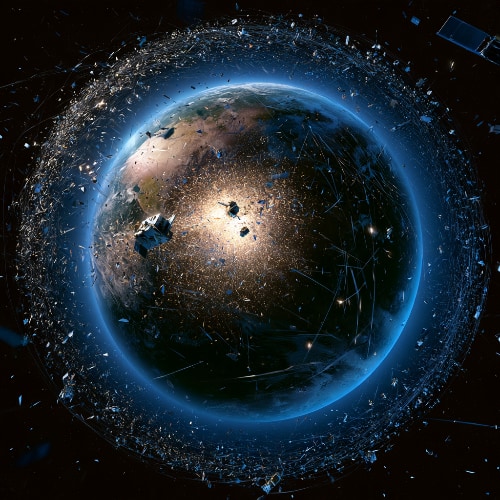
Look up at the night sky and you may already be seeing the beginnings of a profound change.
SpaceX’s Starlink has put thousands upon thousands of satellites into low Earth orbit. Amazon is building its own mega constellation, Amazon Leo, formerly known as Project Kuiper, with plans for more than 3,000 satellites. Other operators are adding still more.
The goal is understandable: blanket the planet with high-speed communications.
But there’s a catch: Space is enormous, but Earth orbit, surprisingly, is not.
Every additional satellite becomes another object moving around the planet at roughly 17,000 miles per hour. And alongside all those functioning spacecraft are dead satellites, discarded rocket stages, and countless fragments of orbital debris.
Most of the time they coexist without incident. But there is a disturbing possibility hiding in all that traffic. One collision creates debris. The debris hits something else, creating more debris. Those fragments hit still more satellites. Eventually, the process starts feeding itself.
It sounds like the setup for a science-fiction disaster.
It also has a name: Kessler Syndrome.
The Chain Reaction in Orbit
NASA scientist Donald Kessler described the basic problem in 1978. Put enough objects into orbit and eventually collisions can generate debris faster than the environment can get rid of it. At that point, you have the possibility of runaway satellite destruction.
This isn’t necessarily the cinematic version, where one satellite explodes and twenty minutes later everything above Earth has been shredded. Orbital mechanics work on much longer timescales. A collision can scatter thousands of fragments into different orbits. Those fragments may circle Earth for years or decades before encountering something else. But when they do, they can create another cloud of debris.
And unlike traffic on a highway, orbital debris moves astonishingly fast. At typical relative orbital velocities, even a small object can cause catastrophic damage.
The danger isn’t one spectacular chain reaction.
It’s a slowly accelerating one.
We’re Already Creating the Ingredients
According to the European Space Agency, roughly 47,000 objects are currently tracked in Earth orbit. The true population is far larger because many objects are too small to track reliably. ESA estimates more than a million pieces larger than one centimeter—large enough to seriously damage or destroy a spacecraft.
And we’re adding spacecraft rapidly.
More than 4,000 payloads were launched into orbit during 2025 alone, driven largely by the growth of commercial satellite constellations.
The interesting—and alarming—part is that simply stopping launches wouldn’t necessarily solve the problem.
ESA says scientific models indicate that the debris population could continue growing even with no new launches because existing objects can collide and create new debris faster than fragments naturally fall back into the atmosphere.
In other words, at some altitudes we may already have enough material in orbit for the problem to sustain itself.
Not All Orbits Are Equal
Kessler Syndrome doesn’t mean Earth suddenly acquires an impenetrable shell of junk. Some orbital regions are much more vulnerable than others.
Lower satellites encounter enough residual atmosphere that their orbits eventually decay. Higher up, debris can remain for decades or centuries. ESA identifies the roughly 600-to-1,100-kilometer region as particularly challenging because it contains substantial amounts of legacy debris. Its models suggest cascading collisions are especially concerning around roughly 900 and 1,400 kilometers.
The likely outcome isn’t that humanity can never reach space again. It’s that particular orbital highways become increasingly dangerous and expensive to use.
That’s bad enough.
Cleaning Up After Ourselves
For years, the obvious answer was to create less debris: move satellites out of valuable orbits when they reach the end of their lives, prevent rocket stages from exploding, and design spacecraft that reenter promptly.
Those measures still matter.
But ESA’s latest assessment goes further. It argues that prevention alone is no longer sufficient. Active debris removal—actually capturing large dead satellites and rocket bodies and taking them out of orbit—will be necessary to stop long-term growth.
That’s an extraordinary engineering challenge. It may also become an unavoidable one.
Humanity spent decades treating orbit as though it were effectively infinite. We’re discovering that the useful parts of it are more like any other shared resource.
Fill them with enough garbage, and eventually the garbage becomes the environment.
The unsettling thing about Kessler Syndrome isn’t that one catastrophic day might suddenly destroy everything in orbit. It’s that there may never be one dramatic moment at all.
Just more debris.
More collisions.
More evasive maneuvers.
And slowly, almost imperceptibly, fewer safe places left to put the next satellite.
Jayson L. Adams is a technology entrepreneur, artist, and the award-winning author of The Quantum Mirror, Ares, and Infernum.
His novels blend high-stakes science fiction, psychological tension, and character-driven suspense. Explore the books at www.jaysonadams.com.