
In Part I of this series, I looked at the surprisingly difficult problem of cooling a data center in space. In Part II, I explored the damage cosmic radiation can inflict on the delicate electronics inside it.
But let’s assume engineers solve both problems.
There’s another question I’ve been wondering about: How exactly do you get a data center into space?
The more I’ve looked into it, the more I’ve realized this isn’t simply a matter of stuffing some servers into a satellite and putting them on top of a rocket. At any meaningful scale, space data centers start running into one of the oldest constraints in spaceflight.
The rocket.
How Big Is a Space Data Center?
The first orbital data centers will probably be relatively small. We already know we can put computers aboard satellites. That’s not particularly revolutionary. But the economic vision being discussed is something much larger: enormous concentrations of computing power fed by equally enormous solar arrays. And that creates a scaling problem.
A terrestrial data center can be the size of a warehouse—or several warehouses. But nobody is going to put a warehouse on top of a rocket.
Launch vehicles impose strict limits on both mass and dimensions. Even if a rocket can lift an enormous payload, everything still has to fit inside or atop the vehicle and survive launch.
That works for something resembling a large satellite.
It becomes much harder when we’re talking about structures potentially spanning hundreds of meters—or eventually kilometers—once the solar arrays and heat radiators discussed in Part I are included.
So we arrive at an uncomfortable choice: either the data center has to fold up, or we have to build it in space.
We’ve Done This Before—Sort Of
There is one obvious precedent: the International Space Station.
The ISS wasn’t launched as a finished space station. Its major components went up over dozens of missions and were assembled in orbit over years But the ISS also required astronauts, robotic arms, spacewalks, repeated resupply missions, and an enormous international spaceflight infrastructure. That’s probably not the model anyone has in mind for making orbital AI economically competitive with a building in Virginia.
The alternative is robotic assembly.
NASA has been working on precisely this problem because future telescopes, communications systems, solar arrays, and other structures may simply be too large to fit inside any rocket fairing. The idea is to launch standardized pieces separately and have robots assemble them after they reach orbit.
That’s fascinating technology. It also tells us something important about space data centers: Once they become sufficiently large, we’re no longer talking about launching a product. We’re talking about launching a construction project.
Imagine Assembling One
Think about what that entails.
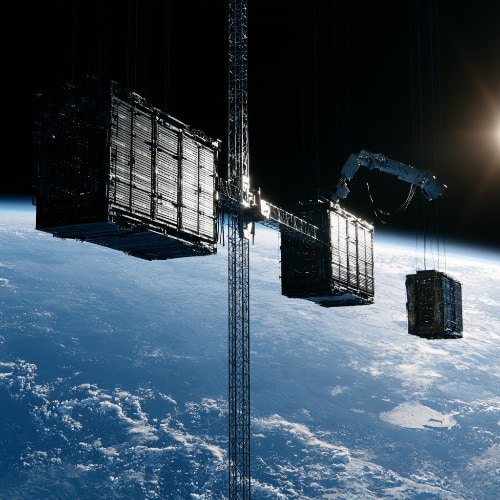
One rocket delivers computing modules. Another carries solar arrays. Others may carry radiator structures, trusses, communications equipment, propulsion systems, power distribution hardware, and robotic assemblers. Every payload has to reach the correct orbit. The pieces have to rendezvous. Robots have to capture them, orient them, and mechanically connect them.
Then come the connections.
High-voltage power. High-speed data. Coolant. Structural connections. Control electronics. Perhaps thousands of individual interfaces spread across an enormous structure. But unlike assembling a data center on Earth, there isn’t a crew of electricians and technicians walking around checking connections and fixing whatever doesn’t work. The assembly system itself has to work.
Size Creates Its Own Problems
Scale is supposed to be one of the great advantages of data centers. Build bigger and you can share power, cooling, networking, and other infrastructure across more computers. In orbit, however, size creates new problems.
The structure has to maintain its shape and orientation. Huge solar arrays need exposure to the Sun. Huge radiators need a clear view of cold space. Communications systems need to point where they’re supposed to point.
And the larger the structure becomes, the more complicated its dynamics become. A kilometer-scale orbital structure isn’t simply a really big satellite. It’s a flexible structure moving at orbital velocity, experiencing thermal expansion and contraction as lighting conditions change, while enormous appendages have to remain properly oriented.
Building it is only the beginning.
We Are Still Learning How to Do This
This is the part I find most striking. In-space assembly isn’t science fiction. NASA has active programs developing robots that can autonomously assemble large structures from modular components.
But look at the scale of what we’re currently demonstrating. NASA has worked on robotic systems to assemble structures measured in meters and tens of meters. Researchers are developing autonomous robots capable of building trusses and other large structures from standardized pieces.
That’s impressive.
But there’s a considerable distance between demonstrating robotic assembly of a 20-meter structure and economically constructing an orbital data center whose power and cooling infrastructure might eventually span kilometers.
We shouldn’t confuse we know how this might work with we know how to do it cheaply and reliably at enormous scale.
The Rocket Is Only the Beginning
That’s what keeps happening as I dig into the idea of space data centers. At first, the concept sounds wonderfully straightforward: abundant solar power, no terrestrial land constraints, and enormous computing capacity in orbit.
Then I start pulling on the engineering threads. Cooling requires enormous radiators. Radiation threatens the electronics. And scale eventually means the data center may become too large to launch as a data center at all.
At that point, the problem has fundamentally changed. You’re not launching a giant computer. You’re launching the pieces of an orbital industrial facility and asking robots to build it hundreds of miles above Earth.
Maybe someday we’ll do exactly that.
But that’s a much bigger technological leap than putting some GPUs on a rocket.
Jayson L. Adams is a technology entrepreneur, artist, and the award-winning author of The Quantum Mirror, Ares, and Infernum.
His novels blend high-stakes science fiction, psychological tension, and character-driven suspense. Explore the books at www.jaysonadams.com.