
Putting data centers in space sounds like one of those ideas that makes perfect sense—as long as you don’t think about it for too long.
AI requires staggering amounts of electricity. In orbit, the Sun shines brightly and predictably. Solar arrays can generate power without consuming land or tapping an electrical grid. Better yet, space is cold, so cooling all those GPUs should be easy.
Free electricity. Free cooling. What’s not to like?
Quite a lot, as it turns out.
The irony is that space data centers, perhaps paradoxically, face an enormous problem getting rid of waste heat.
Space Is Cold, But It Can’t Cool You
I first encountered the counterintuitive physics of cooling in space while reading Andy Weir’s Artemis.
On Earth, we’re surrounded by a wonderfully convenient substance for getting rid of heat: air. Move air across something hot and convection carries thermal energy away. Water is even better, which is why terrestrial data centers increasingly employ sophisticated liquid-cooling systems.
In space, there’s nothing.
A vacuum may be extremely cold, but there’s no matter available to carry your heat away. Ultimately, the only way a spacecraft can dump excess thermal energy into space is through radiation. Not the radioactive kind of radiation, but thermal radiation—the infrared energy that every warm object emits into its surroundings.
The International Space Station provides a spectacular example. It circulates coolant through the station to collect heat, transfers that heat to external ammonia loops, and then pumps the ammonia through enormous radiator panels that radiate the energy into space.
That works, buty the ISS isn’t operating a hyperscale AI data center.
Every Watt Has to Go Somewhere
This is where thermodynamics becomes inconvenient.
Feed 100 megawatts of electricity into a data center and, ultimately, you’ve created roughly 100 megawatts of heat that needs to go somewhere. On Earth, we have air, cooling towers, chilled water, rivers, oceans, and ultimately the atmosphere available to help move that heat.
An orbital data center has a black sky.
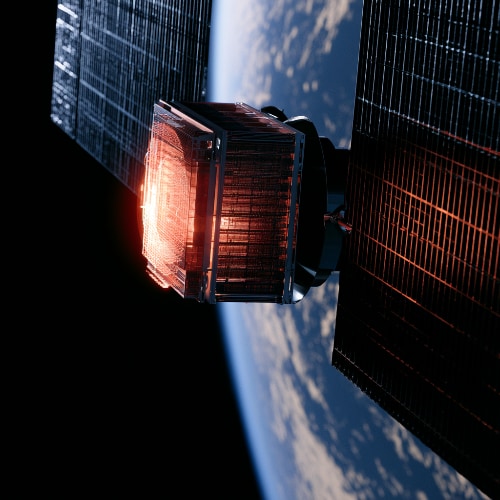
So those wonderful solar panels collecting enormous amounts of energy on one side of your space-based data center need to be accompanied by another enormous structure: radiators capable of rejecting all that energy on the other side.
And there’s another catch. The effectiveness of those radiators depends enormously on their temperature. According to the Stefan-Boltzmann law, the amount of energy a surface can radiate increases with the fourth power of its absolute temperature. In other words, run a radiator hotter and it can reject much more heat from the same surface area.
Unfortunately, computer chips generally prefer the opposite.
Modern GPUs generate enormous amounts of heat in tiny areas and need to remain within relatively narrow operating temperatures. That means an orbital data center would need an efficient system for collecting heat from thousands of chips, moving it elsewhere, and transferring it to radiators operating at temperatures high enough to keep their size and mass practical.
This creates an interesting engineering tension. Higher radiator temperatures mean smaller, lighter radiators—exactly what you want when every kilogram has to be launched into space. But maintaining those higher temperatures while keeping the electronics cool requires increasingly sophisticated thermal-management systems.
The bigger and more powerful the data center becomes, the bigger the thermal problem becomes with it. Suddenly “put the data center in space because cooling is easy” starts sounding a little less convincing.
Physics Always Sends an Invoice
This doesn’t mean space data centers are impossible. But there’s a pattern emerging in some of today’s grand technological visions.
We identify one enormous problem—AI needs tremendous amounts of electricity—and move the infrastructure somewhere that appears to solve it. Then we discover we’ve exchanged the original problem for an entirely new collection of problems. Yes, sunlight in space is abundant. But collecting that energy creates heat that has to be rejected through enormous radiators.
And that’s before we start talking about launching all that hardware, maintaining it, repairing failed equipment, replacing obsolete GPUs, orbital debris, communications, or what happens when thousands of servers inevitably fail.
Space may offer some remarkable advantages for computing.
Free cooling isn’t one of them.
As Artemis reminded me years ago, vacuum doesn’t magically make heat disappear.
In space, physics always sends an invoice.
Jayson L. Adams is a technology entrepreneur, artist, and the award-winning author of The Quantum Mirror, Ares, and Infernum.
His novels blend high-stakes science fiction, psychological tension, and character-driven suspense. Explore the books at www.jaysonadams.com.