
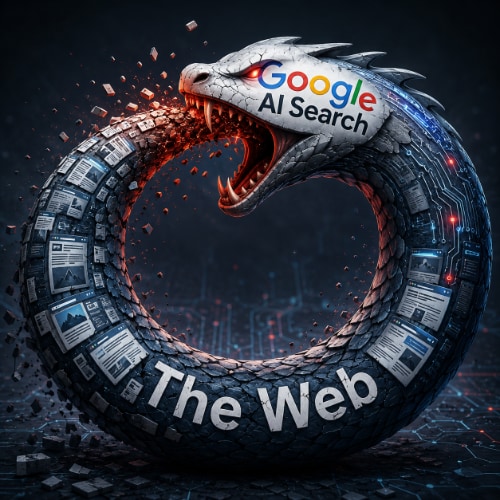
Google Search used to be a deal.
Not a perfect deal. Not always a fair deal. But a deal.
Websites created content. Google indexed that content. Users searched Google, found links, clicked through, and landed on those websites. Once there, publishers, bloggers, reviewers, journalists, and independent creators had a chance to earn money through ads, subscriptions, affiliate links, donations, or some other fragile revenue stream.
That system built much of the modern web. Google became the front door. Websites became the rooms people actually visited.
Now Google seems determined to turn the front door into the whole house.
From Search Engine to Answer Engine
With Google AI Search, the company is no longer just organizing the world’s information. It is increasingly summarizing, remixing, and presenting that information directly inside Google itself.
WIRED’s Steven Levy recently described the shift bluntly: Google’s AI-crafted answers are becoming so convenient that even people who dislike AI may end up using them. At Google I/O 2026, Search chief Liz Reid positioned this as a major reinvention of Search, with Gemini-powered responses replacing the old habit of typing a query and choosing from a list of links.
That may be useful for users. It may even feel magical.
But magic always has a cost. In this case, the cost gets pushed onto the people who created the source material in the first place.
The Old Model Had a Value Exchange
The old Google model depended on an ecosystem. Google needed the web because the web contained the answers. The web tolerated Google because Google sent traffic.
That traffic mattered. A recipe site, a local news outlet, a tech blog, a science explainer, a travel guide, a review site—these businesses survive when people arrive. Pageviews turn into ad impressions. Reader relationships turn into subscriptions. Traffic gives publishers a chance to convert attention into revenue.
Google’s AI answers interrupt that exchange. The user gets the answer. Google keeps the user. The website may get a citation, maybe a link, maybe a tiny nod in the margin—but not necessarily the visit that used to make the whole arrangement economically viable.
Google insists it still sends “billions of clicks” to websites and says AI in Search creates “more opportunities” for sites to appear. It also argues that clicks from AI-enhanced results are higher quality.
That sounds nice. It also sounds like the kind of carefully phrased reassurance a platform gives when it knows the power dynamic has changed.
Paying Lip Service to the Web
In the early stages of AI Overviews, Google at least seemed aware that it needed to reassure publishers. It talked about links. It talked about attribution. It talked about helping users explore.
But the direction of travel is obvious. AI Mode and AI Overviews are designed to reduce the need to click. Google’s own documentation tells site owners that AI Overviews and AI Mode generate responses with supporting links, but it also makes clear that AI is now “built into Search and integral to how Search functions.”
That is not a small feature. That is a new default reality.
And yes, Google has rolled out tweaks, including features that highlight links from publications users already subscribe to. But even that feels like a patch on a much larger wound. Nieman Lab noted that these changes arrive as publishers have reported sharp declines in Google referral traffic, with one Chartbeat study showing search referral drops over two years across small, medium, and large publishers.
Google can call this evolution. Publishers call it extraction.
The “Don’t Be Evil” Era Is Long Gone
None of this should surprise us. The old Google—the quirky, idealistic company that told itself not to be evil—is not the Google we have now.
The modern Google is a massive advertising, cloud, mobile, video, and AI company under constant pressure to grow. It will protect its margins. It will defend its moat. It will keep users inside its products whenever possible.
That does not make the strategy mysterious. It makes it depressing.
Because Google AI Search depends on the web while simultaneously weakening the economic foundation that keeps the web alive. It is using the work of writers, journalists, reviewers, researchers, and creators to generate answers that may prevent users from ever reaching those creators.
That is not innovation in the noble sense. That is a platform eating its suppliers.
What Happens When the Sources Dry Up?
The uncomfortable question is simple: how does the web survive this?
If news sites lose search traffic, they cut staff. If independent blogs lose traffic, they stop publishing. If review sites lose revenue, they either disappear or become even more aggressively optimized, sponsored, and spammy. If original reporting becomes harder to fund, AI systems will have less reliable material to summarize.
Google may not care in the short term. It has enough scale, data, and money to keep the machine running for a while.
But a search engine that stops feeding the web eventually poisons its own well.
Google AI Search may be convenient. It may be inevitable. It may even be impressive.
But it also marks a grim turn in the bargain that built the Internet: the company that once helped users find the web now seems perfectly happy to stand between users and the web.
And if the web breaks under that pressure, Google will not be the only one left with less to search.
Jayson L. Adams is a technology entrepreneur, artist, and the award-winning author of The Quantum Mirror, Ares, and Infernum.
His novels blend high-stakes science fiction, psychological tension, and character-driven suspense. Explore the books at www.jaysonadams.com.